Today I’ve been working on my demonstration of learning for the course I’m currently doing. We were asked to create a postcard or flier which re-tells a bible story or message that has significantly impacted our own faith story.
I know that many are feeling isolated and lonely and that has certainly been my experience at times over the last year. However, when I have hit my lowest points – and there have been a few – that’s when I’ve become aware of the deeper reality of the strong and faithful love that underpins everything. I’ve had to be honest before God about my own weaknesses and fears before I could really rest in this love, and I still don’t always manage it. But, as the title of this blog says, I’m on the journey.
I’ve kept my message simple, because if you’re missing love and community you’re most likely not looking for a long sermon. You really just want someone to see you, recognise you and give you a hug. We’re also in the run-up to Easter, so I’m thinking a lot about the message of hope communicated by the empty cross, and how that might resonate with those who either haven’t heard the story or don’t think it’s for them.
Anyway, this is what I came up with – a postcard to a friend who needs to know they’re loved, and not forgotten. I hope it will also mean something to others who read it. (The music was recorded by musicians and singers from our church, including myself).
I picked up this book just intending to gently browse one or two chapters and got hooked! Edited by Jonny Baker and Cathy Ross, “The pioneer gift” is a collection of case studies by 12 individual pioneers from very different backgrounds and contexts, in which they share what it looks like to work with their gift in specific settings.
What really inspired me about the book is the originality and boldness of the pioneering it showcases, and also that I could relate many of the examples to my own experience. Particularly exciting (and unexpected) is the overlap with my day job at the Open University – for example, the chapter by Jim Barker on Communities of Practice – and with life in general, for example, the importance of hospitality in mission. “The Pioneer gift” also speaks into my current church community. We are embarking on a big mission project and the insights about context and looking for what God is already doing are very relevant.
The case studies are very individual and varied, showing that for each of us, God can use our particular gifts and experience to achieve something new – we don’t have to fit a particular mould. Indeed, one of the messages of the book, expressed by Jonny Baker in Chapter 1, is that pioneers tend to have “the gift of not fitting in” because they can see different possibilities to what exists at present, and are people with the will and ability to bring their vision into being. As Gerald Arbuckle puts it, pioneers are “dreamers who do”. I’ve quite often felt a little out on a limb in church situations so it was a relief to read that this is normal when challenging the status quo. Cathy Ross in her chapter on “Pioneering missiologies: seeing afresh” picks up on this, talking about ‘theological homelessness,’ discomfort and pilgrimage.
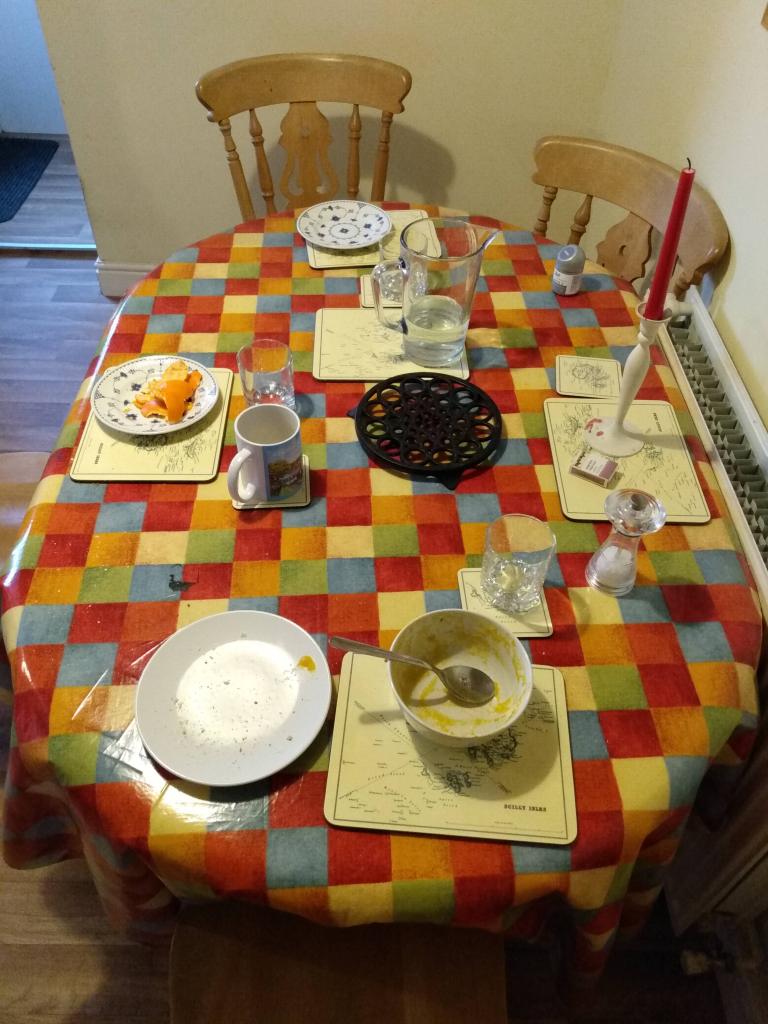
Our kitchen table
Several themes running through the book resonate with me on a deep level. One is the central role of hospitality in mission. Cathy Ross talks about “a missiology of the kitchen table”. Related to this is the idea that like Jesus we go to people in vulnerability and weakness rather than with all the answers, and live on their terms. It challenges our notions of success, and of measuring church growth only by numbers attending services on a Sunday. Instead, it puts the focus on the quality of relationships, on partnership and on living humbly alongside our fellow human beings, sharing the gospel in the communities we’re part of.
Numerous other contributors pick up on this idea of missional community being an open table where all are welcome and everyone learns together – what Kim Hartshorne refers to as “the sacramental pattern around eating together”. It fits with the idea of Communities of Practice, in which “learning…fundamentally consists of social participation” (Barker, p.99). As we share life together, we learn together. An integral part of my life has been offering hospitality in my own home and joining together with others – in professional Communities of Practice too – to create larger-scale gatherings for people to come together for food, conversation and learning.
I was struck by the idea of “little theologies” (Cathy Ross, p. 34) – knowing a local context or community in enough depth to meaningfully communicate the good news of Christ there. This fits with subsidiarity, which is about self-determination and empowering people to make decisions on the smallest local level possible. Karlie Alloway in chapter 5 “Pioneer mission in community” talks about the importance of doing pioneering mission together with others, so that we not only communicate the resurrection, but also live out its reality (Alloway, p.80). This is a clear message in the Bible too (for example, John 13:34-35 and 1 John 3).
Beth Keith’s chapter -“To pluck up and to pull down, to build and to plant” (quoting Jeremiah 1:10) highlights the tension between traditional and emerging forms of church, and that traditional structures and practices need to be dismantled in order for new forms of church to emerge. I agree with her view that “The cultural divide between church and society today suggests our new contexts are just outside the doors of our churches” (Keith, p. 135).
Andrea Campanale and Emma Nash both tackle the important area of how we define “sin” in our current time. It is more helpful to address the false shame and sense of estrangement that people – perhaps especially women – feel, than to focus exclusively on specific acts of wrongdoing. Andrea Campanale points out that “identity is no longer externally determined but dependent on our sense of self (p.183).” People’s sense of self can be very distorted but the stories in our faith tradition provide a different narrative of God-given identity, love and forgiveness. This offers hope and healing to those whose lives are marred by misplaced shame. Anna Ruddick’s research (Chapter 6, “Transformation”) suggests that “for transformation to be coherent and lasting an individual must have a sense of self that is positive and affirmed” rather than try to fit into a different cultural group. (Ruddick, p.65). It’s not about trying to drag people into our existing churches. We should also not neglect structural injustice – where people have been the victim of sin this must be called out (Nash, p.209).
Overall, I didn’t find much to disagree with, although some of the chapters were quite academic in nature and there was a bit of jargon to get to grips with (e.g. sodal and modal, acculturation, ecclesiology, pneumatology, subsidiarity). So I needed a dictionary in one hand while reading! Once I got behind the terminology, most of it made sense. I did have more difficulty relating Doug Gay’s chapter to my own situation as he is an ordained minister who favours an attractional model, centred on worship that takes place in church buildings. I agree that worship is very important and can have a profound impact on people; however, for the last 16 years of my life I have worshipped in school buildings and don’t see a church building as necessary to build relationships and community.
This book has expanded my thinking in many ways, with lots of questions to ponder and some possible avenues for action. These include:
exploring what hospitality and mission looks like in different communities I’m part of, and deciding which community to focus on
seeing if the Community of Practice model would help to bring people from any of the groups I’m part of together for food, conversation and journeying together.
being a ‘contemplative activist’ (Alloway, p.91-2) with action flowing out of a life of prayer.
To take forward the ideas that are forming, I will need to look at some of the more practical ‘how to’ guides that exist and talk with others. This book has been great at opening my eyes to the possibilities and encouraging me to feel I could be part of what God is already doing.
I’ve just started out on a course in Pioneering Mission Leadership Training run by CMS At present it is all online and via Zoom, but hopefully that will change as the vaccine gets rolled out more widely and we can eventually meet in person. Following induction on 9th January our first full day of training took place on 16th January. Here are a few reflections from the first day.
For our worship at the start of the day we read Psalm 139 and listened to part of Beethoven’s 5th Symphony. This was a great reminder of how God knows us and loves us in the deepest way possible. One of my passions is playing the violin and the last time I played together with others was on 14th March 2020 just before lockdown – a concert of music by Beethoven featuring Beethoven 5. Although aspects of our identity might seem dormant or hidden, especially at the moment in lockdown, God has not forgotten who he created us to be.
The gospels are a great place to start in seeing how Jesus pioneered (Hebrews 12:2) and to consider “how to prolong the logic of the ministry of Jesus in a new era” (Bosch, 1991, p.34). For our first activity we talked in breakout groups about Jesus’s example in the story of the Samaritan woman (John 4). We saw how Jesus crossed several boundaries – tribal, gender, geographical – in speaking to the woman. He made himself vulnerable by asking her for a drink and built a relationship of respect. We noted that the Samaritan woman is the first person with whom Jesus shares his identity as Messiah in John’s gospel (John 4:25-26). She then goes back to her city and shares Jesus with others and through the transformation Jesus brings about in her she attracts people to come and hear Jesus for themselves. The good news for the woman is that she was seen and heard by Jesus and this strikes me as one of the most valuable things we can do for people.
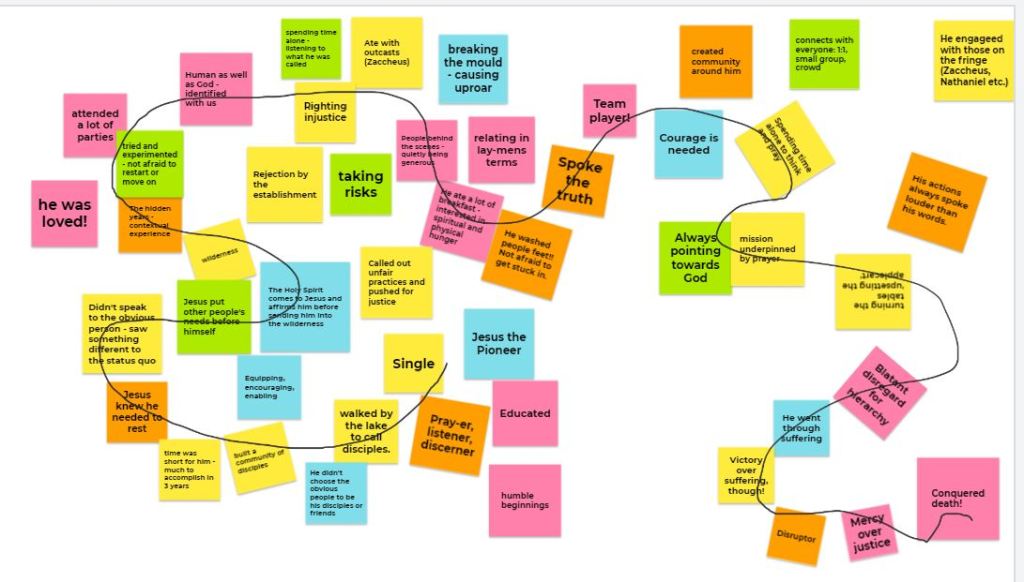
The next activity in our breakout groups was to add notes to the Google Jamboard (see picture below) on what Jesus’s life as a pioneer looked like. It was fun to see the board filling up really quickly. We noticed that although Jesus didn’t pick the obvious people to be his disciples, they became an amazing team. Jesus was loved by God but went through wilderness times and this is a common experience of pioneers. Mission can be scary and we noted Jesus’s incredible courage as well as the quiet generosity of people behind the scenes in supporting him.
We then talked about key themes in the video Jonny had shared earlier:
What is mission (we are doing God’s mission or Missio Dei)
What does pioneering mission look like? Jonny had referred to “the gift of not fitting in” and some of us could relate to that
The challenge of change in any new system with the tension of newness versus tradition. A lot of pioneering new things is about justifying it and building relationships.
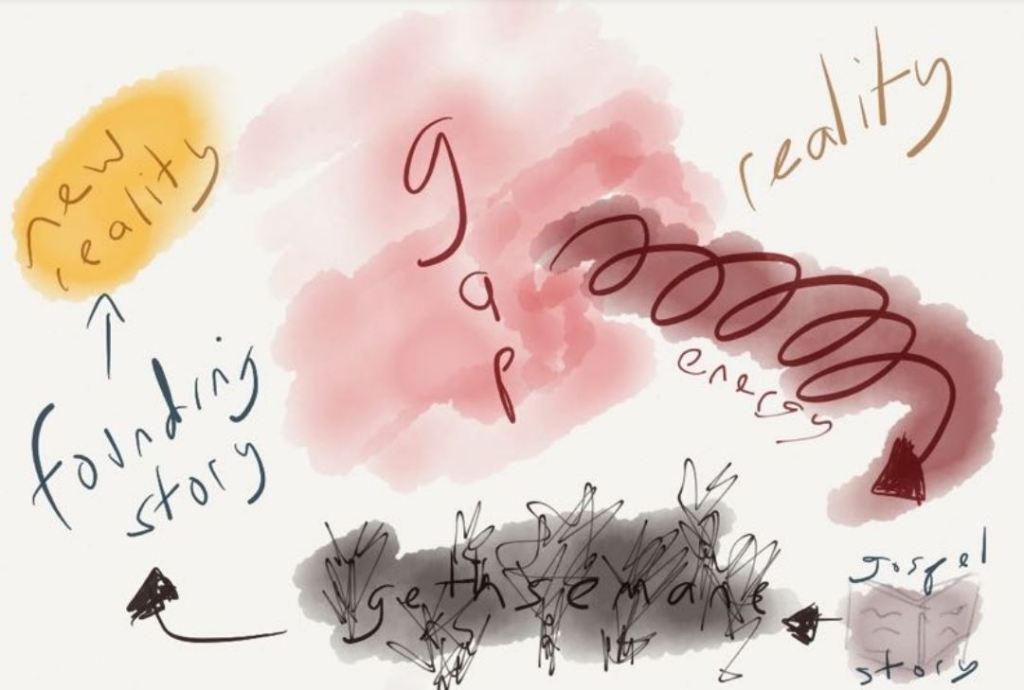
What steps we might take to start on the journey. We were introduced to several tools to help us reflect where we are in relation to pioneering, including The founding story by Gerald Arbuckle, which gets us to think about the gap of dissatisfaction or frustration, from where the energy for pioneering change can come.
This was a good chance to stand back and reflect. It linked with the idea that our life’s work is coming home to who we truly are (a phrase used by my spiritual director too). If we pioneer out of our true selves we will be more fruitful.
We shared some of our stories with each other in pairs, before doing some further reflection on what makes us angry, what we are passionate about and what we are good at. Jonny wisely advised us to do some “soul work” to look after who we are and address those trickier aspects of our character.
Finally, we looked at the Pioneer Spectrum, with some useful examples (though sadly not all have been able to continue under lockdown) and a chance to think together about how we could Replicate, Adapt or Innovate in a physical space (which in this case was a pub, The Pioneer Arms). We noted that context is important, but we also need to be real about what we bring to the context. Jonny introduced us to an online interactive tool https://churchmissionsociety.org/files/cardgame/index.html?v9 which we can use to explore this further.
What I love about our training so far is how interactive and thought-provoking it is. I spend long hours in front of a screen for work and church activities at the moment, but the CMS training didn’t feel arduous. It would be wonderful to meet in person, but until we can, the online environment is being used imaginatively. I also really appreciated the way jargon was explained.
Oh yes, and what is a pioneer?
Beth Keith: “A pioneer is someone who sees future possibilities and works to bring them to reality.” The hashtag #DreamersWhoDo is a neat summary of the pioneer type.
References
Bosch, David (1991) Transforming mission: paradigm shifts in theology of mission, New York: Orbis.
An important part of finding your groove as a pioneer is to have good self-awareness, or as Jonny Baker put it learning to “be you”. This is an area I’m engaging with at the moment. There are various tools you can use to do a bit of self-reflection. With my current lockdown brain, deep reflection doesn’t come very easily but I’m giving it a go with the online interactive tool which we can use to explore what we bring to our context. Here’s how it panned out for me…..
The other 2 questions covered context, that is: Paradigm, and People & Place. No card flipping, but some questions to ponder (in a playful way). For example (Paradigm), What determines community to your community? To what extent is the sacred and secular connected / disconnected? Or when thinking about People and Place: we live in a medium-size market town with many families and people of working age, greater diversity than used to be the case when we arrived 20 years ago, moderate community cohesion and a lot of people not involved in faith communities. Actually, community cohesion is good in many ways, but the newer estates on the eastern side of town (where our church meets) lack community or the spaces where community might easily happen. Our church community is quite small, covers a spread of ages but mainly 40s and younger, with quite a number of young families.
We considered where we and our churches are on the Pioneer spectrum. In terms of our church, we are currently doing fairly traditional church on Zoom (or in a school hall when we’re allowed to meet). So that sits on the left of the spectrum. At one time, Messy Church was a big part of church life, which is just to the right of where we now sit. Other activities I’ve done that could be classed as pioneering have been out in the community, often bringing together a mixture of people from church and non-church backgrounds around a common cause, for example, parents and toddlers, homelessness or social justice. There was no particular agenda, though interesting conversations did arise and sometimes people were drawn into the church community (though not necessarily my specific church).
There is more work to do to assess my pioneering tendencies. Quickly going through Enneagram suggested I am an enthusiast (type 7), but I need to revisit this as my natural tendency is to score myself quite high on everything, in an enthusiastic kind of way.
We looked at Gerald Arbuckle’s Founding story picture, which portrays a process for starting something. This starts with a gap of dissatisfaction or frustration, which generates the energy for change. Arbuckle calls the challenge of going through this process ‘Gethsemane’. Gethsemane is a wilderness – a kind of liminal space on the frontiers. It would be nice if pioneering didn’t have to involve this, but in practice it pretty much always does.
When thinking about my own church situation, some of my frustrations have been around the fact that we focus mostly on the existing members of the church and not very much on those on the margins or unconnected with church. At present, our church has a fairly minimal impact on the surrounding community, although that is gradually changing. Like many others, I’m concerned about the impact of COVID-19 lockdown on mental health and community, especially where children and young people are concerned.
My small response to this so far has been to go out, and encourage others to go out. We have done several prayer walks. Before Christmas we went carol singing on the estate, which met with a a very positive response, and clearly touched some people quite deeply – once they realised we weren’t the Rotary club Santa float and weren’t there to fundraise. In better times we would be offering food and friendship through shared meals and children’s activities. In previous years we put on a Beer and Carols event which proved highly popular. But for now, we wait, pray and listen.
My final reflection is on the activity Jonny Baker led us in, to identify what makes us angry, what we’re passionate about and what our talents are. I feel anger about people and the environment being hurt through injustice and selfishness, and about the systems and structures that do not challenge these wrongs or allow the voices of marginalised and vulnerable people to be heard. My passions include social justice, music, hospitality, education, building community, and getting out as much as possible! I identified that I’m good at facilitation (which is a form of leadership not always recognised), bringing people together, spotting opportunities, organising events, building relationship, making things happen, encouraging / mentoring / supporting others.
I’m still working on the personal statement that encapsulates all this neatly, but so far it looks something like this….
I’m good at spotting opportunities to develop networks and bring people together (often around food), building communities where everyone is heard, valued and can grow in their experience of God.
References
Arbuckle G, Refounding the Church, (London: Geoffrey Chapman, 1993)
 On the journey