
Recently our church (Church of the Good Shepherd Sandhills) held an informal social drop-in morning for church members and the wider community. One of the first tasks facing us was to figure out how to put up the gazebo lent by a family who were not going to be there in person. It took about 10 of us on the job, figuring out what to do and trying different approaches. We didn’t all know each other that well beforehand. I start by mentioning this, because it felt great tackling the job together, and reminded me that discipleship is about doing life and overcoming challenges together!
The Fresh Expressions journey
“Fresh Expressions are new forms of church that emerge within contemporary culture and engage primarily with those who don’t ‘go to church”
https://freshexpressions.org.uk/about/what-is-a-fresh-expression/
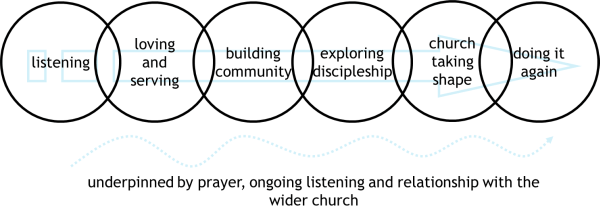
The Fresh expressions journey involves several steps to guide the development of a Fresh Expression, shown in the diagram below. These can be summarised as “Listen, Love, Community, Share Jesus, Church, Repeat.” They are overlapping and not necessarily linear, but do help those pioneering a Fresh Expression to see what the next step might be.
Background and context
The church to which I belong is a church plant on a new estate on the south-east side of our town, a growing market and commuter town of around forty thousand people. The church is now eight years old and my husband and I have been there for half that time. It originally grew out of Messy Church and still has a very healthy focus on children and young people. There are around twenty-five adults who regularly attend, and from ten to twenty children, although this fluctuates.
How did the church develop?
At the time when these particular new estates were being built, a Community Missioner Priest was employed by All Saints, the mother church, to lead the initial outreach work and to engage with local residents. The Sandhills Community House was open from April 2011 – August 2016 as part of the Sandhills Community Action Project. During that time the local Voluntary & Community Action service commissioned some research on Creating social value in new communities (2014), which identified that “feelings of isolation is one of the most common experiences reported by the residents we engaged with right across the age spectrum” (p.11).
This initial phase of the church’s development involved listening, loving and serving, building community in the process, as the pioneer missioner discerned and responded to the need for companionship and community, particularly amongst young families. There was a lot of drinking coffee, sharing life and building relationship. The first three stages of the Fresh Expressions journey therefore happened together over a period of time.
A regular Messy Church gathering started at the Community House (‘Exploring discipleship’ stage) and by 2014 had gathered enough momentum for Church of the Good Shepherd to start holding regular services each week. A team (and Parochial Church Council) was gathered to lead the new church, with a lot of support from All Saints. The style of church was very different to the mother church, but in the context of the new estates it worked. Families had a place where they could get together regularly and a community they could be part of.
Where are we now?
The Community House closed in 2016, just before the arrival of a new vicar. This heralded a time of change. Over time, many of the original church members dropped away. Some of this was because families moved on, or children outgrew the Messy Church format. Perhaps also for some people, engagement with church had been mainly limited to Sundays once a month, which had restricted the opportunities for much real sharing of life (Discipleship) to take place.
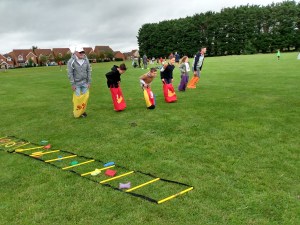
At the current time we are once again in a time of listening, loving and serving, aiming to build community. The COVID-19 pandemic meant that many plans were put on hold, though regular Sunday services and a weekly house group continued via Zoom. However, it has also provided some opportunities. We have started regular monthly drop-ins at Astral Park Community Centre. As the Centre is now unstaffed, our church has the go-ahead to serve coffee and cake to the community – outside the Community Centre so visible to all – on a Sunday morning. We are also leading different themed activities, most recently a mini Olympic games.
We are using this both to build church community and to find out from the wider community what matters to them. So far, areas being highlighted include friendship and belonging, echoing the original research by the Voluntary & Community Action service. There are not enough facilities for children and young people, and the roads on the estate don’t feel safe for children to cross. A Community Outreach Worker employed by the Baptist Church has lived on the Sandhills Estate for 20 years, since the first houses were built, and commented on the social divisions that exist, with the need for reconciliation in places.
Where next?
The idea of a journey implies forward movement, but in reality the process seems more circuitous. It seems to me that we are revisiting some of the building blocks of church. Our listening, loving and community building are particularly important as we come out of the pandemic. We are looking to work in partnership with others in the community as we move forward, being aware of the impact of the pandemic on many people’s mental health and well-being. We are aware that ‘the community’ is not one cohesive group and our listening must take in different demographics. The expression of church that emerges may well be different to what has gone before.
Are other routes possible? One scenario is that we will grow a number of smaller church communities, starting with current Good Shepherd church members and their friends. The character of these groups will depend very much on the nature and interests of those who are drawn into them. It is also important to build community traditions and events that different people of all ages can enjoy, such as the annual Beer and Carols event, and carol singing on the street. Alongside this, there are plans to employ a Community Missioner to lead a wider range of outreach activities.
Learning and growing together
The gazebo experience gives a clue to one of the key ingredients of authentic church. As people loved by God, our calling is not to do religious things so much as to follow Jesus the Good Shepherd, journeying with others through the reality of life’s ups and downs. Our first two monthly drop-ins have been joyous and life-affirming occasions. They reflect the Messy Church values of creativity, hospitality and celebration. We are happy sheep and we long to welcome others!
Sharing Jesus (what we refer to as discipleship) happens naturally as we support and learn from each other. I wonder if it is actually the most important thing in growing Fresh Expressions of church?
References
Karl Leathem and Joelle Bradley (Lodestar), Creating social value in new communities, 2014
 On the journey