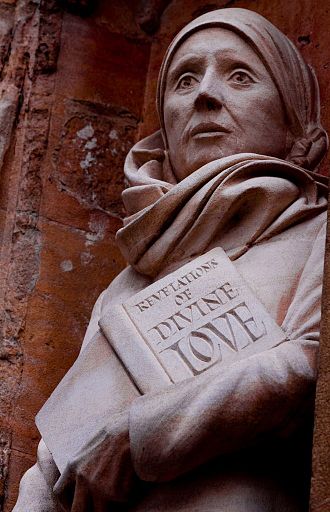
Over the last year I’ve been introduced to the writing of Julian of Norwich. (Just watched a fantastic documentary by Dr Janina Ramirez which gives a great insight into Julian’s life including her book Revelations of divine love).
Julian lived from approximately 1342 – 1416 or so. She was an important figure in medieval times who challenged prevailing Christian views by sharing her radical experience of a loving God who displays motherly qualities, as revealed to Julian in a series of visions of the crucifixion. A powerful if untutored writer, Julian authored the first book in English by a woman.
After a near-death experience, she took vows to become an anchoress (hermit) and spent the rest of her life in a cell attached to St Julian’s church in Norwich, from which she took her name. Julian lived through huge upheaval, including two pandemic-like plagues. Yet she saw God as looking on us with immense compassion and without blame. God does not condemn or accuse us, and He wants us to know how much we are loved.
She wrote the much-quoted words:
“All shall be well, and all shall be well, and all manner of thing shall be well.”
(Julian of Norwich, Revelations of Divine Love)
This resonates with the words of Captain Sir Tom Moore, “tomorrow will be a good day” – which I referred to in a previous post, From Carousel to COVID
Julian interacted with the outside world through three windows: one where she received food and water and had her basic physical needs met; the second facing onto the church, where she received the sacraments, and the third looking on to the busy street outside, where Julian received visitors and chatted to them. Ian Adams in his book Cave, Refectory, Road, uses these three windows as a metaphor for different aspects of mission spirituality:
- Cave – personal wellbeing and health, including spiritual wellbeing
- Refectory – our church context
- Road – our window onto the world and metaphor for our pioneering context.
Mission here refers to God’s mission in the world and is not restricted to what the church might be doing. It is important to note that spirituality and mission are inextricably bound up with each other and can’t be separated. There is overlap between all three aspects of mission spirituality and the balance is important in life’s rhythm.
Julian’s insights seem particularly important for the time we are living in – a kind of dark ages in which many feel isolated, unloved and fearful. Margaret Coles comments that:
Julian’s kind, comforting words are as fresh and relevant as though she had spoken them a minute ago.
From: https://julianofnorwich.org/blogs/reflections/why-julian-of-norwich-is-a-mystic-for-troubled-times
This speaks into my own experience of lockdown life and in my next blog post I shall explore the first of these dimensions of spirituality: Cave.
 On the journey
Hi Kath, this is very interesting, I’ve come across the famous quote from Julian (which you quoted) but you have given me a powerful image through your description of the room with three windows. I’ll try to read at least some of her work if I’m able to get hold of a copy, and I will try to check out your future posts in this series. Best wishes, Steven (a fellow spirituality blogger).
LikeLiked by 1 person