Over the last few weeks our CMS pioneer training group has been thinking about some tools to help us reflect. The “Doing theology” reflective spiral by Laurie Green is an excellent way to bring reflection and action to bear on each other in an interplay that he terms “praxis.” It is about dissolving the distinction between theory and practice. Green’s model helpfully starts with our lived reality (Experience) and invites us to Explore, Reflect and Respond. This then takes us back to Experience, but with new insights.
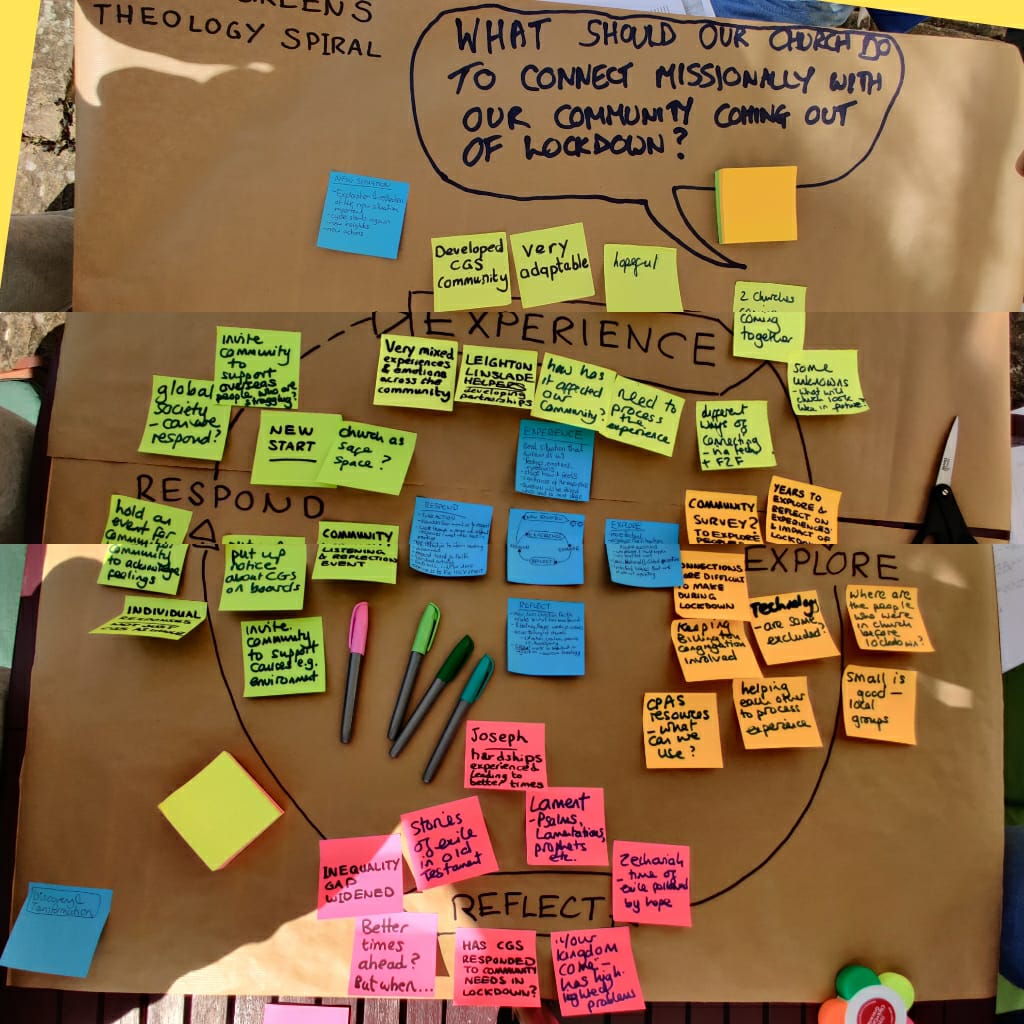
Laurie Green comments that “theology is best done in a group” (Green, p.22) so our little band of pioneers-in-training from Church of the Good Shepherd (CGS) Sandhills met one Saturday morning over coffee to pool our brains. The image below shows what we came up with.
Our question is “What should our church do to connect missionally with our community coming out of lockdown?”
Experience
We first of all thought about where we are now. During lockdown our church, CGS, came together with the other church our vicar is responsible for, St Michael & All Angels, Billington, for joint services on Zoom. CGS members proved to be very adaptable and quickly moved to using technology to connect both on Sundays and midweek. We also worked in partnership with Leighton-Linslade Helpers to join in with virtual events and support their foodbank. Now that our church communities are able to meet face-to-face, we are holding hybrid services. Not everyone joined the online meetings – so we celebrate the friendships made, but recognise that some people have drifted away. We’re also aware that many around us have never connected with church in the first place. Before lockdown we planned to hold a community lunch, but weren’t able to go ahead. Many of us, church members or not, are struggling with grief, loss and weariness. We need to process the experience we have been through.
Explore
We agreed that it had been challenging to stay connected during lockdown. Technology works for some but has excluded others, often the more vulnerable such as elderly people and children. We wondered where some of the people are now who were in church before lockdown. Small local groups have been valuable, and connecting more with our neighbours. We acknowledged that it could take years to come to terms with the experiences and impact of lockdown. Making time to process things together – church and wider community – feels important. We could get useful perspective from community leaders such as local councillors. The Resources for the recovery phase produced by CPAS are also very helpful.
Reflect
This part of the discussion was particularly valuable in highlighting relevant parts of the Bible that individually we might not have thought of. There are many stories of exile in the Old Testament. For example, Joseph, whose challenges and hardships lasted for many years, but eventually led to better times. It provoked the question of when these better times might be for us…. The lament found in the Psalms, prophets (for example, Zechariah) and book of Lamentations gives voice to the sadness and loss that many are feeling. We felt that the inequality gap in society had widened and wondered if our church had done all it could to respond to community needs during lockdown?
Respond
I have noticed when talking to others that people’s responses to the pandemic are very individual. We need to allow for these personal responses, as well as providing opportunity for us all to process feelings collectively. One possibility that we are actively investigating is a “Hope after COVID” event for people to acknowledge both losses and gratitude, and relax together over tea / coffee and cake. This is not a one-off but the first step of many. In the longer term we also talked about bringing people together around causes such as environment or mental health. It will be a case of trying something, listening and learning, with the “Doing theology” spiral a useful structure to guide us.
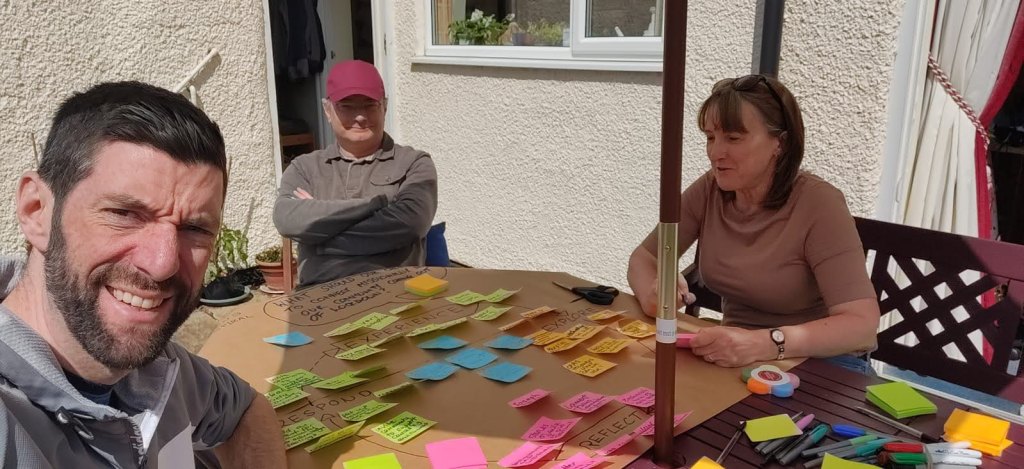
The team in action….
References
Green, Laurie (2009) Let’s do theology, chapter 2, A new way to do theology.
 On the journey