An important part of finding your groove as a pioneer is to have good self-awareness, or as Jonny Baker put it learning to “be you”. This is an area I’m engaging with at the moment. There are various tools you can use to do a bit of self-reflection. With my current lockdown brain, deep reflection doesn’t come very easily but I’m giving it a go with the online interactive tool which we can use to explore what we bring to our context. Here’s how it panned out for me…..
- Principle – Activist (2 cards), Innovator (2 cards) and Adaptor (1 card)
- Pioneering practice – Innovator (2 cards), Activist (2 cards) and Adaptor (1 card)
- Personality – Innovator (2 cards), Activist (2 cards) and Adaptor (1 card)
The other 2 questions covered context, that is: Paradigm, and People & Place. No card flipping, but some questions to ponder (in a playful way). For example (Paradigm), What determines community to your community? To what extent is the sacred and secular connected / disconnected? Or when thinking about People and Place: we live in a medium-size market town with many families and people of working age, greater diversity than used to be the case when we arrived 20 years ago, moderate community cohesion and a lot of people not involved in faith communities. Actually, community cohesion is good in many ways, but the newer estates on the eastern side of town (where our church meets) lack community or the spaces where community might easily happen. Our church community is quite small, covers a spread of ages but mainly 40s and younger, with quite a number of young families.
We considered where we and our churches are on the Pioneer spectrum. In terms of our church, we are currently doing fairly traditional church on Zoom (or in a school hall when we’re allowed to meet). So that sits on the left of the spectrum. At one time, Messy Church was a big part of church life, which is just to the right of where we now sit. Other activities I’ve done that could be classed as pioneering have been out in the community, often bringing together a mixture of people from church and non-church backgrounds around a common cause, for example, parents and toddlers, homelessness or social justice. There was no particular agenda, though interesting conversations did arise and sometimes people were drawn into the church community (though not necessarily my specific church).
There is more work to do to assess my pioneering tendencies. Quickly going through Enneagram suggested I am an enthusiast (type 7), but I need to revisit this as my natural tendency is to score myself quite high on everything, in an enthusiastic kind of way.
We looked at Gerald Arbuckle’s Founding story picture, which portrays a process for starting something. This starts with a gap of dissatisfaction or frustration, which generates the energy for change. Arbuckle calls the challenge of going through this process ‘Gethsemane’. Gethsemane is a wilderness – a kind of liminal space on the frontiers. It would be nice if pioneering didn’t have to involve this, but in practice it pretty much always does.
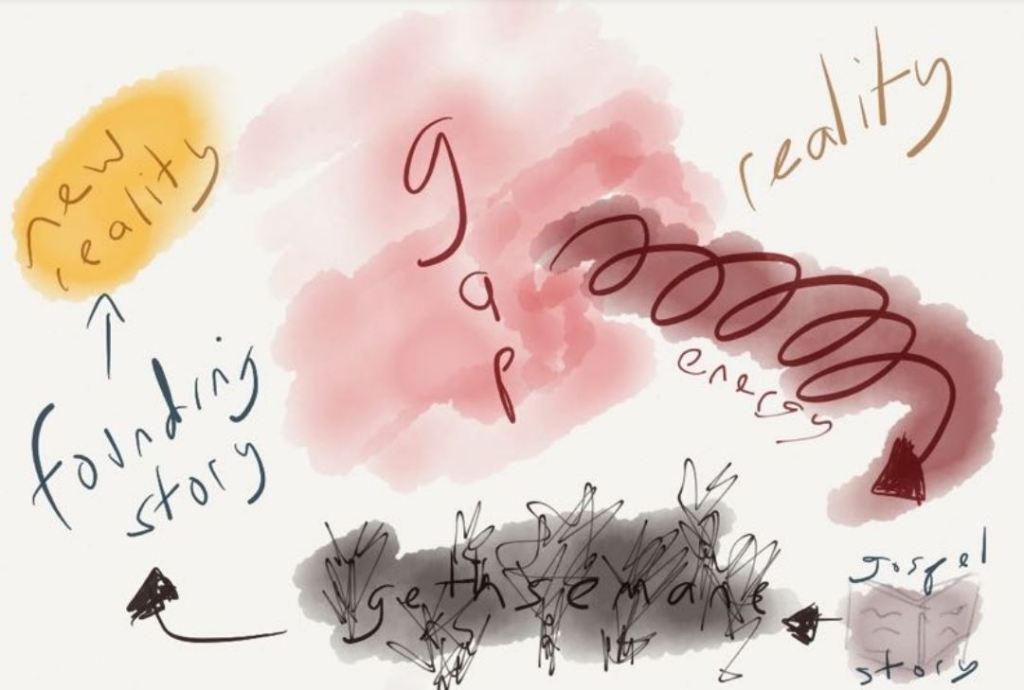
When thinking about my own church situation, some of my frustrations have been around the fact that we focus mostly on the existing members of the church and not very much on those on the margins or unconnected with church. At present, our church has a fairly minimal impact on the surrounding community, although that is gradually changing. Like many others, I’m concerned about the impact of COVID-19 lockdown on mental health and community, especially where children and young people are concerned.
My small response to this so far has been to go out, and encourage others to go out. We have done several prayer walks. Before Christmas we went carol singing on the estate, which met with a a very positive response, and clearly touched some people quite deeply – once they realised we weren’t the Rotary club Santa float and weren’t there to fundraise. In better times we would be offering food and friendship through shared meals and children’s activities. In previous years we put on a Beer and Carols event which proved highly popular. But for now, we wait, pray and listen.
My final reflection is on the activity Jonny Baker led us in, to identify what makes us angry, what we’re passionate about and what our talents are. I feel anger about people and the environment being hurt through injustice and selfishness, and about the systems and structures that do not challenge these wrongs or allow the voices of marginalised and vulnerable people to be heard. My passions include social justice, music, hospitality, education, building community, and getting out as much as possible! I identified that I’m good at facilitation (which is a form of leadership not always recognised), bringing people together, spotting opportunities, organising events, building relationship, making things happen, encouraging / mentoring / supporting others.
I’m still working on the personal statement that encapsulates all this neatly, but so far it looks something like this….
I’m good at spotting opportunities to develop networks and bring people together (often around food), building communities where everyone is heard, valued and can grow in their experience of God.
References
Arbuckle G, Refounding the Church, (London: Geoffrey Chapman, 1993)
 On the journey